
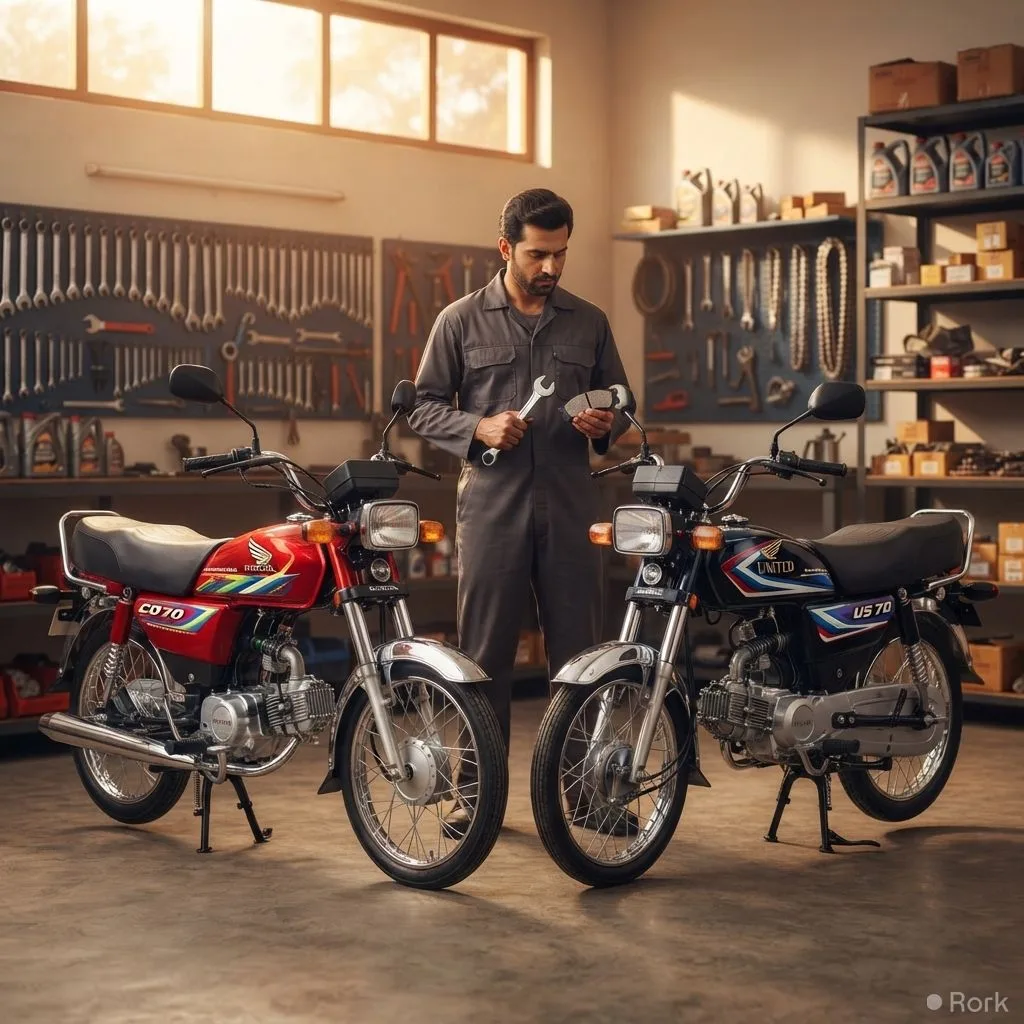
Honda’s flagship 70 cc commuter, the CD 70, is projected to cost roughly 30 percent less in yearly upkeep than its rival, the United US 70, according to a new cost‑analysis released by Verified Pakistan on 21 September 2026. The study, which aggregates current market prices for parts, service labour and fuel across the country, places the average annual maintenance bill for a CD 70 at about PKR 4,800, whereas a US 70 owner can expect to spend close to PKR 6,700 for the same period.
The lower figure for the CD 70 stems mainly from its extensive, decades‑old supply chain and the relative affordability of its replacement components. Spare‑part pricing for the Japanese‑made bike is consistently below that of the United‑manufactured model; for instance, a standard brake‑pad set for the CD 70 averages PKR 850, while the equivalent part for the US 70 is priced around PKR 1,250. Similarly, clutch‑kit replacements—one of the more frequent service items on both machines—run about PKR 1,200 for the Honda and roughly PKR 1,650 for the United.
Fuel efficiency further widens the cost gap. The CD 70’s proven mileage, hovering in the mid‑60 km per litre range under typical city‑riding conditions, translates into noticeable savings when petrol prices hover above PKR 300 per litre. By contrast, the US 70’s real‑world consumption settles closer to the high‑50 km per litre mark, meaning an extra PKR 200–300 per month for the average commuter. Over a year, that difference adds up to roughly PKR 2,500 in fuel expenses alone.
Repair labour also leans in Honda’s favour. Because the CD 70 enjoys a nationwide network of authorized service centres and a large pool of independent workshops familiar with its engine design, hourly labour rates are generally lower, often by 10‑15 percent compared with the rates charged for United’s model. The study notes that routine services—oil changes, valve adjustments and chain maintenance—cost an average of PKR 1,200 on a CD 70, whereas a comparable US 70 service is billed at about PKR 1,600.
For Pakistani riders, especially those on tight budgets or commuting long distances, the disparity in ownership costs carries practical significance. With fuel prices climbing steadily and disposable incomes under pressure, a savings of nearly PKR 2,000‑3,000 per year can influence buying decisions for first‑time buyers, students and small‑business owners who rely on a motorcycle for daily transport. Dealers also stand to benefit from the data, as the lower total‑cost‑of‑ownership narrative may reinforce Honda’s market dominance in the 70 cc segment, while United may need to reassess its pricing strategy for parts and service to stay competitive.
In sum, while both the Honda CD 70 and the United US 70 remain among the most affordable two‑wheelers on Pakistani streets, the comprehensive cost analysis underscores the Honda’s edge in long‑term affordability. The combination of cheaper spare parts, better fuel mileage and reduced service charges gives the CD 70 a clear advantage for riders seeking to minimise the financial impact of everyday commuting.