
Key points
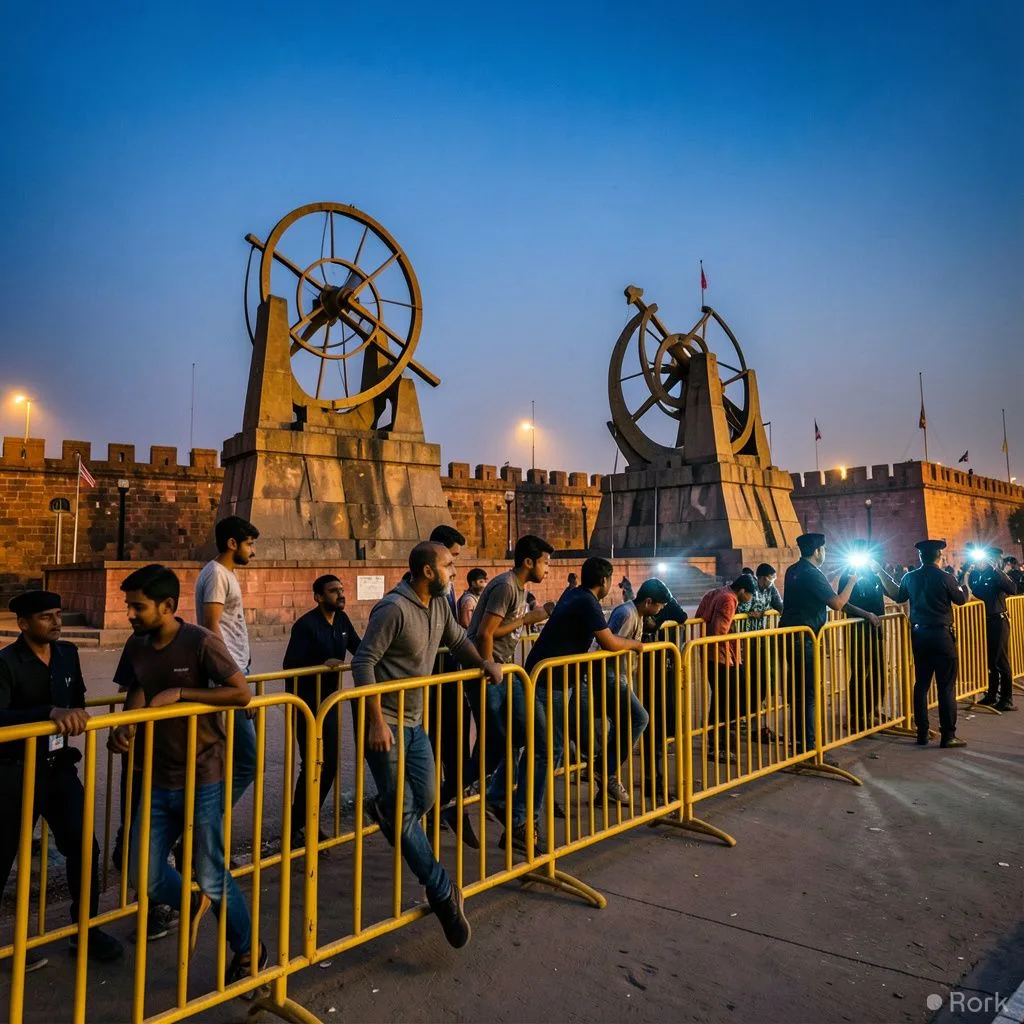
- Police cordoned off Jantar Mantar with bright‑yellow metal barricades as the youth‑led Cockroach Janta Party staged a flash protest.
- Video footage captured party activists scrambling over the barriers before law‑enforcement moved in and detained several senior leaders.
- Prime Minister Narendra Modi labeled India the “mother of democracy” while denouncing the disruption as an affront to public order.
- Authorities placed multiple top figures of the Cockroach Janta Party under police custody for interrogation.
The protest erupted on Tuesday morning at New Delhi’s historic Jantar Mantar, a site that has long served as a venue for political rallies. Within minutes of the crowd gathering, police erected a perimeter of yellow metal barricades, effectively sealing off the area. Despite the obstacles, members of the Cockroach Janta Party – a self‑styled, youth‑driven outfit that has gained attention for its unconventional branding and anti‑establishment rhetoric – surged forward, scaling the barriers in a brief but highly visual showdown. Security personnel responded swiftly, dispersing the demonstrators and escorting several senior party officials to the nearby police station for questioning.
Prime Minister Narendra Modi, speaking shortly after the incident, praised India’s democratic heritage, describing the nation as the “mother of democracy.” He condemned the protest as an attempt to disturb public peace and warned that any act undermining law and order would be met with decisive action. The government’s rapid containment of the episode underscores its low tolerance for spontaneous street movements that could spiral into larger unrest.
The Cockroach Janta Party, founded only a few years ago, has positioned itself as a voice for disillusioned young voters, leveraging social media and flash‑mob tactics to draw attention. While still marginal in electoral terms, its ability to mobilise quickly and attract media coverage has raised concerns among established parties about the potential for similar groups to exploit civic spaces for political messaging.
For Pakistan, the incident serves as a reminder of the volatility that can surface within India’s domestic political landscape. Heightened internal tensions often spill over into bilateral dialogues, especially on issues such as trade, border management, and diaspora affairs. A stable Indian internal environment is crucial for the smooth conduct of ongoing India‑Pakistan confidence‑building measures, and any escalation of street protests could distract policymakers from addressing shared challenges like water sharing and regional security.