
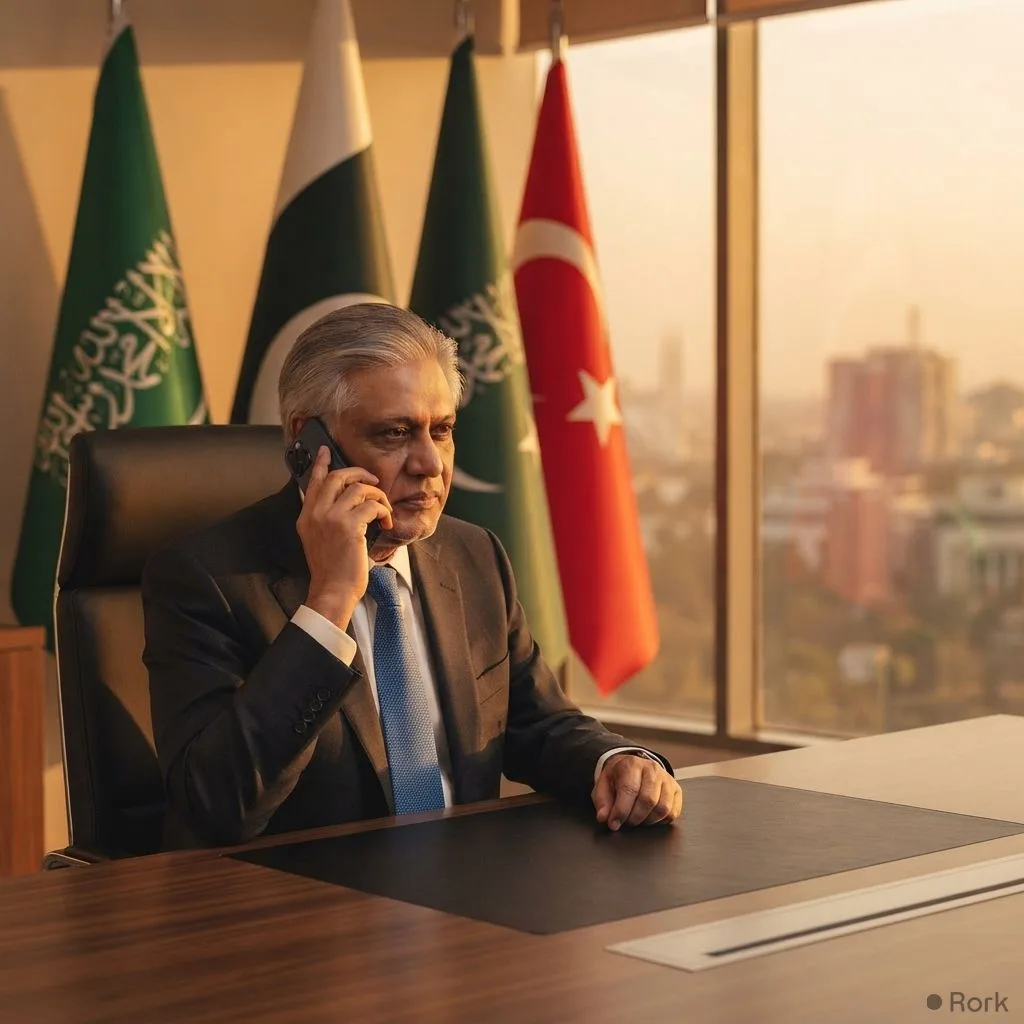
Deputy Prime Minister and Foreign Minister Ishaq Dar spoke individually with Saudi Arabia’s Foreign Minister Prince Faisal bin Farhan and Turkey’s Foreign Minister Hakan Fidan on 6 September 2026, reviewing the breakthroughs achieved at the recent Istanbul gathering on the Makkah defence alliance and reaffirming a commitment to maintain close coordination as the trilateral framework moves toward formalisation.
In the call with Riyadh, Dar thanked Saudi officials for their willingness to deepen security cooperation and underscored Pakistan’s intent to act as a strategic conduit between the two partners. The discussion touched on the operational protocols that will govern joint patrols, intelligence sharing and the deployment of rapid‑reaction forces along the Red Sea corridor. Both sides agreed to set up a joint coordination cell in Islamabad to streamline communications and to schedule a series of high‑level workshops on maritime security and counter‑terrorism.
During the separate conversation with Ankara, Dar and Hakan examined the practical steps needed to translate the Istanbul understandings into actionable plans. They deliberated on a schedule of combined training exercises for air‑force squadrons and special‑operations units, as well as the integration of Turkish defence technology with Pakistani platforms. The ministers also explored a unified stance on emerging threats, ranging from Iran‑aligned militias to the growing influence of non‑state actors in the Horn of Africa, signalling a broader strategic alignment beyond the immediate Makkah framework.
Both foreign ministers echoed the Istanbul summit’s consensus that the Makkah pact should serve as a stabilising axis for the wider region. They pledged to keep the lines of communication open, with regular teleconferences and a rotating chairmanship for the alliance’s steering committee. Dar highlighted that Pakistan’s geographic position and its historical ties with both the Gulf and Anatolia uniquely equip it to facilitate dialogue, mediate disputes and ensure the alliance’s operational coherence.
The talks arrive at a moment when Pakistan is seeking to diversify its defence partnerships and reduce reliance on traditional suppliers. By anchoring itself at the centre of the Makkah defence network, Islamabad hopes to attract joint‑venture projects, technology transfers and procurement opportunities that could modernise its armed forces and boost the domestic defence industry. Analysts note that the pact may also provide Pakistan with diplomatic leverage in its longstanding disputes with India, while offering Saudi Arabia and Turkey a reliable South Asian partner to counterbalance regional rivalries.
The Makkah alliance, first mooted in early 2025, aims to create a coordinated security architecture spanning the Arabian Peninsula, the Eastern Mediterranean and the northern Indian Ocean. As the three governments move from diplomatic declarations to concrete implementation, the coming weeks are expected to see the drafting of a formal treaty, the establishment of a joint secretariat in Islamabad and the planning of inaugural joint exercises slated for early 2027.