
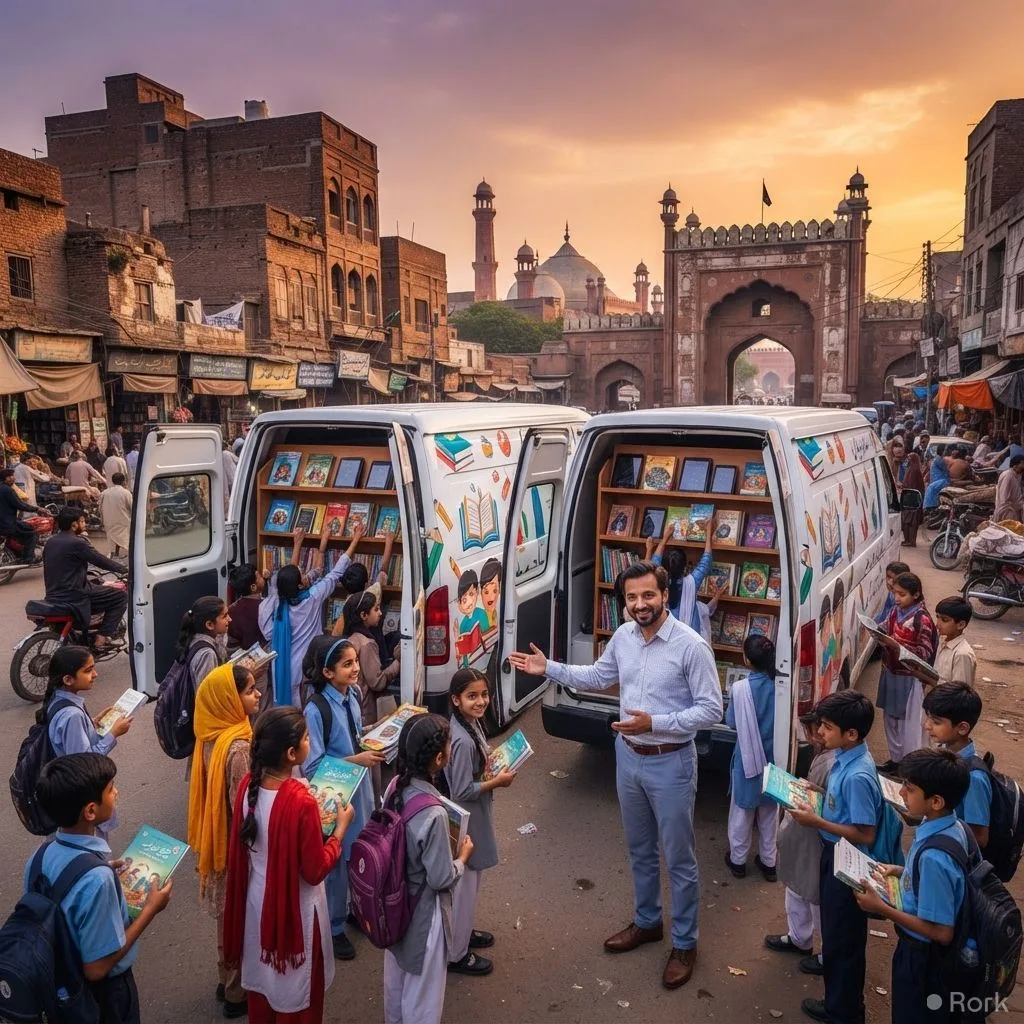
Lahore’s municipal authorities have unveiled a new “Libraries on Wheels” programme that will bring books, textbooks and digital learning kits directly to school‑age children across the city. The initiative, slated to begin operations next month, will see specially outfitted vans travelling through residential neighbourhoods and visiting schools on a weekly timetable.
The mobile libraries are intended to fill a long‑standing gap in educational resources, especially in districts where school libraries are either non‑existent or severely under‑stocked. By placing a librarian on each vehicle, the project hopes to create a familiar, approachable point of contact for students who might otherwise have limited exposure to a variety of reading material.
Background
Pakistan’s public‑school system has struggled with inadequate library infrastructure for decades. A 2024 audit by the Punjab Education Department found that only 28 % of government schools in Lahore had functional libraries, and many of those that existed suffered from outdated collections and insufficient staffing. The shortfall has been linked to low reading proficiency scores and a waning culture of leisure reading among youth.
In response, the Lahore Development Authority (LDA) partnered with the provincial Department of Education and several local NGOs to design a mobile solution. The concept draws on successful “book‑bus” models implemented in Karachi and Hyderabad, where similar fleets have increased library usage by up to 45 % in pilot neighbourhoods. Funding for the current rollout comes from the municipal budget, supplemented by a grant from the Punjab Higher Education Commission aimed at promoting digital literacy.
The vans have been retrofitted with climate‑controlled shelving, Wi‑Fi hotspots and tablets pre‑loaded with curriculum‑aligned e‑books. Each vehicle will carry a rotating stock of 1,500 items, ranging from Grade‑1 storybooks to senior secondary science textbooks, as well as interactive learning kits for subjects such as mathematics and coding.
What it means
For students in low‑income areas of Gulberg, Shahdara and Samanabad, the service removes the need to travel long distances to the nearest school library or commercial bookshop. A child can now borrow a set of textbooks for the week, return them to the van on its next route, and pick up new titles without leaving the neighbourhood. This convenience is expected to improve attendance at after‑school study sessions and reduce the dropout rate that often spikes when educational materials are hard to obtain.
Teachers, too, stand to benefit. The mobile librarians will coordinate with school staff to align the rotating collection with the current syllabus, ensuring that supplementary reading material is always relevant. Moreover, the on‑board Wi‑Fi and tablets provide a low‑cost gateway to digital resources, enabling teachers to integrate e‑learning into their lesson plans without requiring a separate ICT lab.
Parents may see a shift in household reading habits as the vans become a community hub. Past mobile‑library projects in other Pakistani cities have reported increased family engagement with books, as adults accompany children to borrow items and discover resources for adult literacy programmes. Such community‑wide participation can nurture a culture of lifelong learning that extends beyond the classroom.
What happens next
The first fleet of three vans is scheduled to hit the streets on 15 October, covering a rotating circuit of 12 neighbourhoods. Each van will follow a published weekly schedule posted on the LDA website and displayed at local schools, allowing families to plan visits in advance. Librarians on board will conduct brief orientation sessions for new borrowers, teaching them how to catalogue, handle and return materials responsibly.
The municipal government has pledged to monitor usage statistics, borrowing rates and user feedback for the first six months. If the pilot meets its targets—aiming for at least 10,000 active users city‑wide—the plan calls for an expansion to six additional vans by early 2027, potentially extending the service to neighboring districts such as Sheikhupura and Kasur. Stakeholders see the project as a scalable model that could be replicated in other Pakistani metropolises seeking cost‑effective ways to boost educational access.