
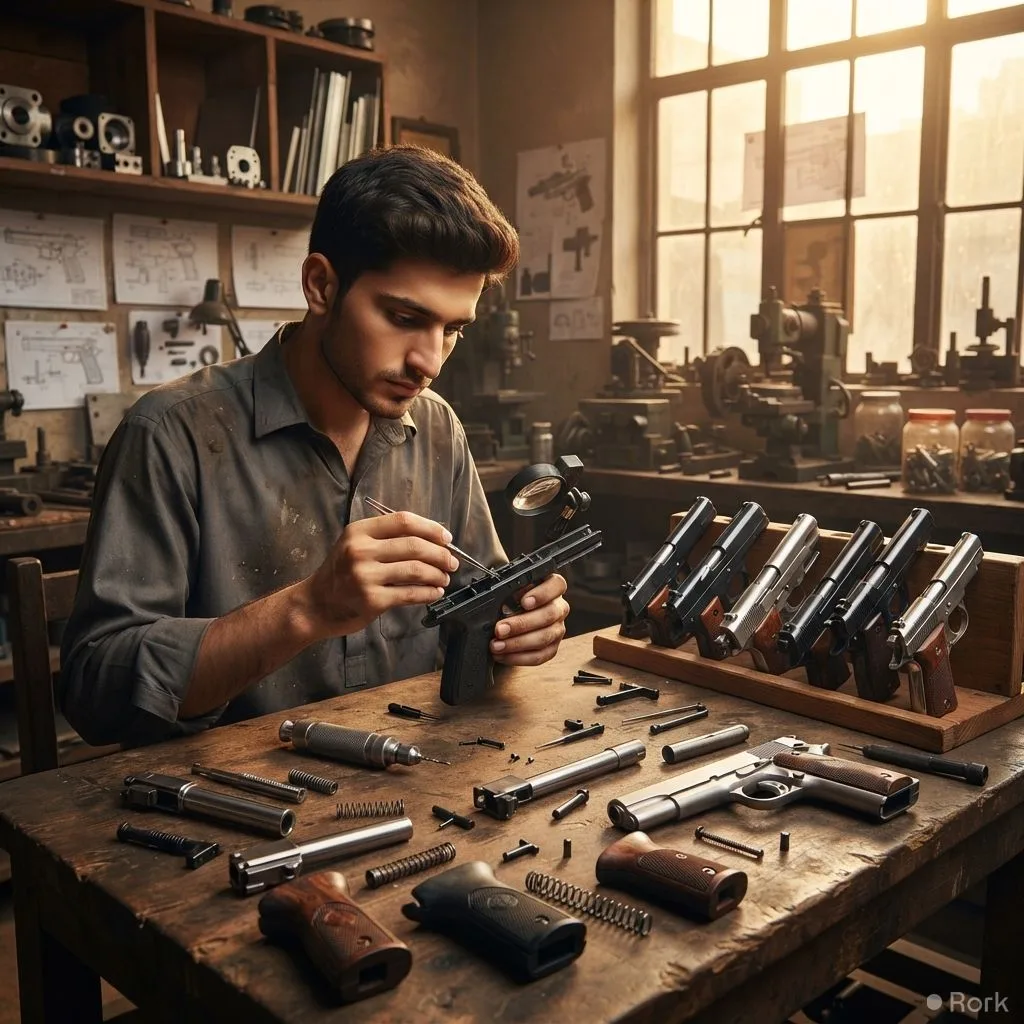
A 22‑year‑old metal‑working prodigy from Faisalabad has announced that he can hand‑craft roughly 170 distinct pistol models, a claim that has already attracted purchase inquiries from collectors and specialty dealers in Europe and the Middle East. The young artisan, Muhammad Ali (full name withheld for security), unveiled the breadth of his portfolio during a private showing at his modest workshop on 30 September, prompting several overseas buyers to request quotations within days.
Ali’s workshop, a converted garage fitted with a CNC milling machine, a precision lathe and an array of hand tools, blends traditional South Asian metal‑craft techniques with modern engineering software. Each pistol is fabricated from high‑grade steel, with components such as barrels, slides and frames machined in‑house before undergoing heat‑treatment and fine‑tuning. According to the young maker, the collection spans classic revolvers, semi‑automatic pistols, and a handful of experimental designs inspired by historical firearms, all produced without the assistance of large‑scale factories.
The surge of interest reflects a growing appetite for niche, artisanal weapons among global collectors who value originality over mass‑produced pieces. Industry observers note that Pakistan’s burgeoning maker community, bolstered by recent government incentives for small‑scale manufacturing and technical training programs, is increasingly capable of delivering high‑precision products that meet international standards. Ali’s success could therefore serve as a bellwether for other skilled craftsmen seeking export opportunities beyond the country’s traditional textile and leather sectors.
While the pistols are intended for display and limited‑edition sales to licensed owners, Ali stresses that every piece complies with Pakistan’s Arms Ordinance and the relevant export control regulations. He has instituted a strict vetting process for buyers, requiring proof of legal possession and adherence to safety protocols. The young entrepreneur also collaborates with local law‑enforcement advisors to ensure that his creations are not diverted to illicit channels.
Local authorities have responded positively, viewing the development as a potential boost to the nation’s high‑skill manufacturing base. The Ministry of Industries has previously highlighted the need to diversify export portfolios, and Ali’s venture aligns with those objectives by showcasing Pakistan’s capacity for precision engineering. However, officials caution that any expansion into the international firearms market must be tightly regulated to avoid contravening both domestic law and international arms‑control treaties.
Looking ahead, Ali plans to formalise his operation by registering a small‑scale enterprise and seeking certification under the Pakistan Standards and Quality Control Authority. He hopes to partner with domestic universities to mentor other aspiring craftsmen, thereby fostering a cluster of specialized workshops that could collectively elevate Pakistan’s reputation in the global niche‑manufacturing arena.