
Key points:
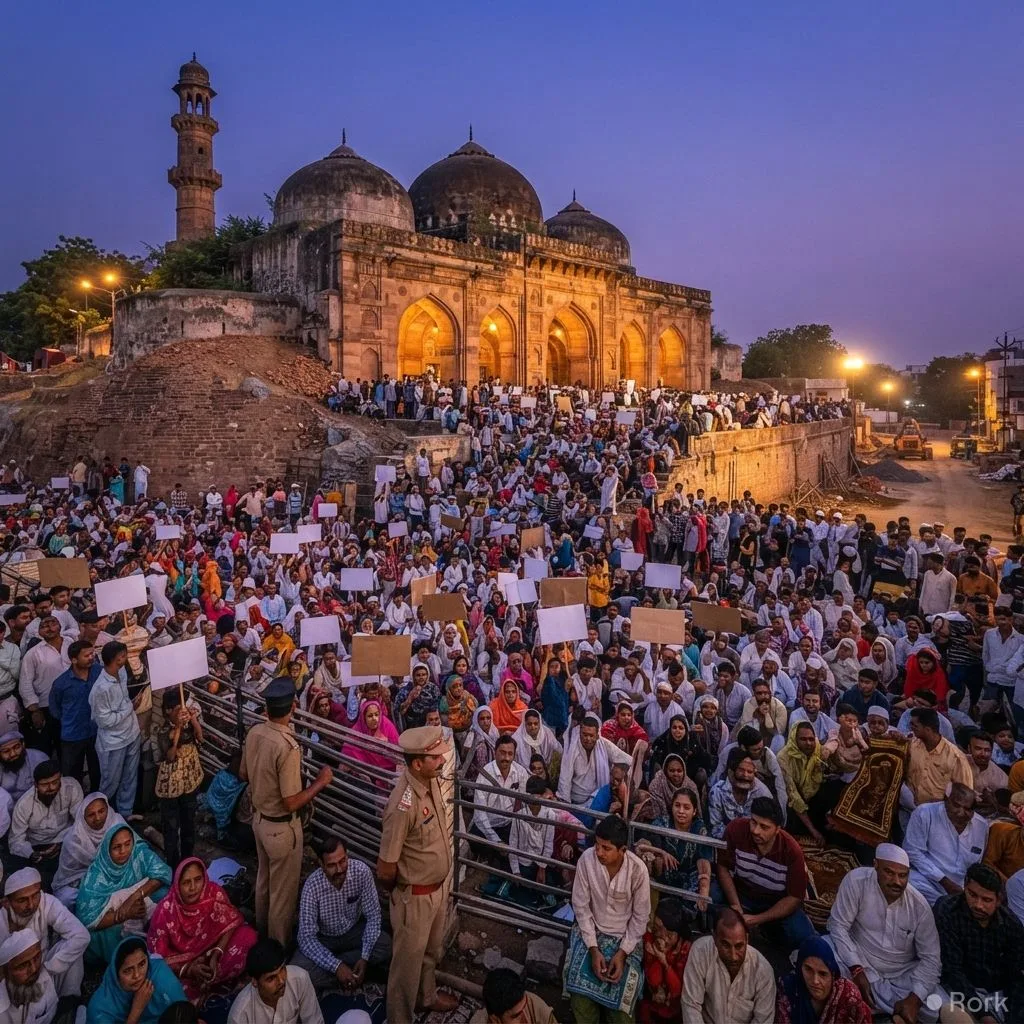
- Thousands of Muslims gathered overnight in Ujjain, Madhya Pradesh, to oppose the partial demolition of the 600‑year‑old Shahi Mosque and its minaret.
- The demolition is linked to a state‑run road‑widening and redevelopment scheme that would affect the historic complex.
- Protesters carried prayer mats, flags and placards, demanding that the heritage structure be preserved.
- Authorities have deployed police to monitor the site, but the demonstration continued into the early hours, reflecting growing tension between heritage conservation and urban planning.
The crowd that assembled on the banks of the Kshipra River in Ujjain included elders, youth and community leaders who set up makeshift prayer areas before the protest began. Their main grievance was that the proposed partial demolition would not only damage a centuries‑old monument but also erase a symbol of the city’s Mughal‑era Islamic legacy. The Shahi Mosque, built in the early 15th century, is one of the few surviving examples of Indo‑Islamic architecture in the region and is listed by local heritage bodies as a protected site.
State officials say the road‑widening project is part of a broader “Smart Cities” initiative aimed at easing traffic congestion on a busy arterial route. According to the Madhya Pradesh Urban Development Authority, the demolition would involve only a small section of the mosque’s outer wall and minaret to accommodate a wider carriageway. However, heritage activists argue that any alteration compromises the structural integrity and spiritual value of the monument, urging the government to explore alternative alignments or engineering solutions.
The protest in Ujjish has resonated beyond India’s borders, prompting reactions from neighboring Pakistan where several religious and cultural groups monitor the treatment of Islamic heritage sites across the subcontinent. Pakistani scholars have warned that the erosion of such historic edifices could fuel communal sensitivities, especially in regions where minority rights and heritage preservation are already contentious. The incident adds to an ongoing South Asian discourse on how to reconcile rapid urban development with the safeguarding of monuments that embody shared cultural memory.