
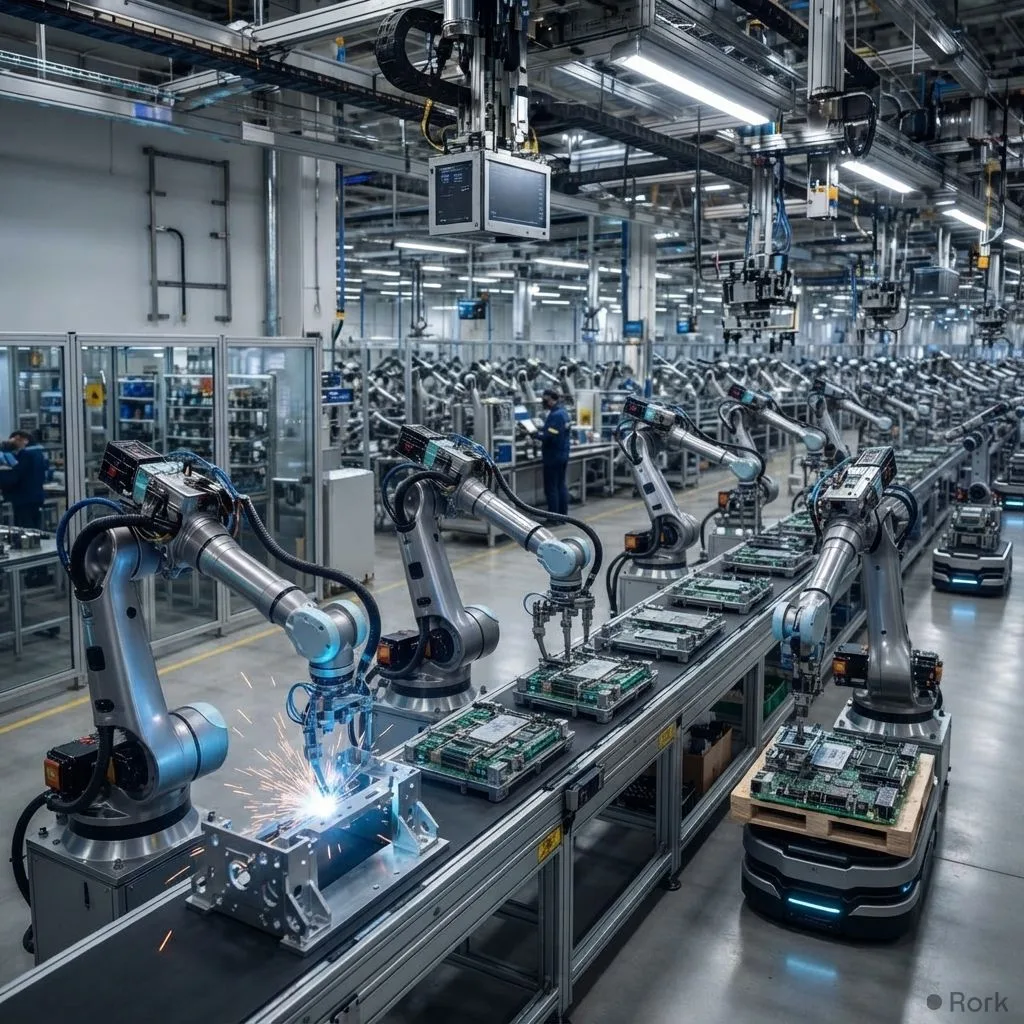
Over five million industrial robots are now active on production floors around the globe, marking a new milestone in the worldwide shift toward automated manufacturing.
Background
The rapid climb to the five‑million‑robot threshold has been driven by a combination of falling hardware costs, advances in sensor technology, and the integration of artificial‑intelligence algorithms that allow machines to perform more complex tasks with minimal human supervision. Over the past decade, manufacturers in the automotive, electronics and consumer‑goods sectors have progressively replaced repetitive manual operations—such as welding seams, assembling components, packing products and conducting visual inspections—with robotic systems that deliver higher precision and lower defect rates.
In emerging economies, the adoption curve has accelerated as governments and industry bodies promote “Industry 4.0” initiatives aimed at modernising ageing production lines. Countries like China, India, Mexico and South Korea have become major buyers of collaborative robots (cobots) that can work side‑by‑side with human operators. The cumulative effect of these trends has pushed the global robot count past the five‑million mark, according to the latest data compiled by Business Bytes.
What it means for Pakistan
For Pakistan’s manufacturing sector, the surge in robot deployments presents both opportunity and challenge. Companies that produce automobiles, textiles, pharmaceuticals and consumer electronics can now consider robotic solutions to boost output, improve product quality and reduce reliance on overtime labour. In regions such as Faisalabad and Sialkot, where garment and leather factories dominate, a modest uptake of automation could help meet rising export standards and compete with lower‑cost rivals.
However, the same data that celebrates productivity gains also highlights a looming skills gap. As robots take over repetitive tasks, the demand for workers proficient in robotics programming, maintenance and data analytics is expected to rise sharply. Pakistan’s technical education system and vocational training institutes will need to revamp curricula and forge partnerships with equipment suppliers to equip the local workforce for these new roles, lest large segments of low‑skill labor face displacement.
What happens next
Industry analysts predict that the next wave of growth will be powered by collaborative robots equipped with advanced AI vision and machine‑learning capabilities, allowing them to adapt to variable product designs without extensive reprogramming. This flexibility makes automation attractive for small‑ and medium‑sized enterprises (SMEs) in Pakistan, which have traditionally been hesitant to invest in large, dedicated robotic cells.
Policymakers are therefore urged to craft incentive schemes—such as tax credits, low‑interest loans and export‑linked subsidies—that lower the entry barrier for SMEs while simultaneously supporting reskilling programmes. If these measures are put in place, Pakistan could capture a share of the global robot boom, turning what might be a disruptive technology into a catalyst for higher‑value manufacturing and sustainable job creation.