
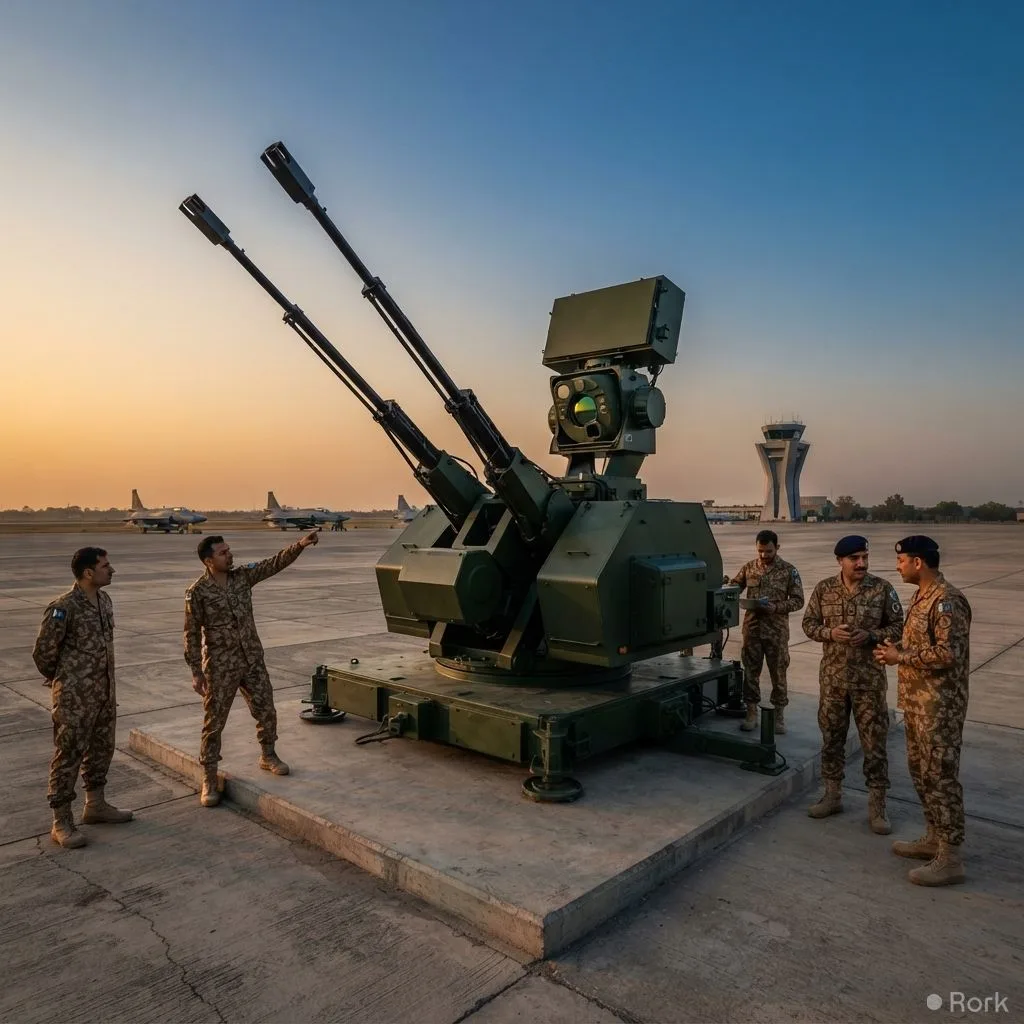
In recent weeks, the spectre of low‑altitude aerial incursions—from swarming drones to precision cruise missiles—has pressed defence planners across South Asia to rethink their short‑range air‑defence postures. Against that backdrop, Pakistan’s air‑force marked Defence Day with a striking visual statement: a short film that places Turkey’s KORKUT 35 mm air‑defence system at the centre of its emerging shield.
The Pakistan Air Force (PAF) unveiled the Turkish‑made KORKUT in the newly released Defence Day video, highlighting the system’s ability to detect, track and engage a spectrum of low‑level threats. Featuring a dual‑mount 35 mm autocannon paired with an advanced fire‑control radar, KORKUT can automatically lock onto fast‑moving targets such as cruise missiles and unmanned aerial vehicles, delivering rapid, high‑precision fire to neutralise them before they breach protected airspace.
Beyond the on‑screen showcase, the adoption of KORKUT signals a deepening defence collaboration between Islamabad and Ankara. Turkey has been a key supplier of military hardware to Pakistan for years, and the integration of this platform expands that partnership into the realm of networked, short‑range air defence. Analysts note that KORKUT’s modular design allows it to be linked with existing Pakistani radars and command‑and‑control nodes, creating a layered protective envelope around strategic assets such as power stations, oil depots and forward operating bases.
For the PAF, the system fills a critical gap in its legacy air‑defence architecture, which has largely relied on older Soviet‑era equipment ill‑suited to counter today’s proliferating drone swarms and hypersonic cruise weapons. By fielding KORKUT, Pakistan aims to bolster the survivability of its air corridors and border installations, particularly in the volatile north‑western frontier where cross‑border UAV activity has risen in recent months.
The rollout of KORKUT also carries broader regional implications. A more capable short‑range shield not only raises the cost for any adversary contemplating low‑altitude strikes but also reinforces Pakistan’s narrative of self‑reliance and modernisation in its defence capabilities. As the PAF moves toward full operational integration, the system is expected to become a cornerstone of a revamped air‑defence network that can respond swiftly to the evolving aerial threat landscape of South Asia.