
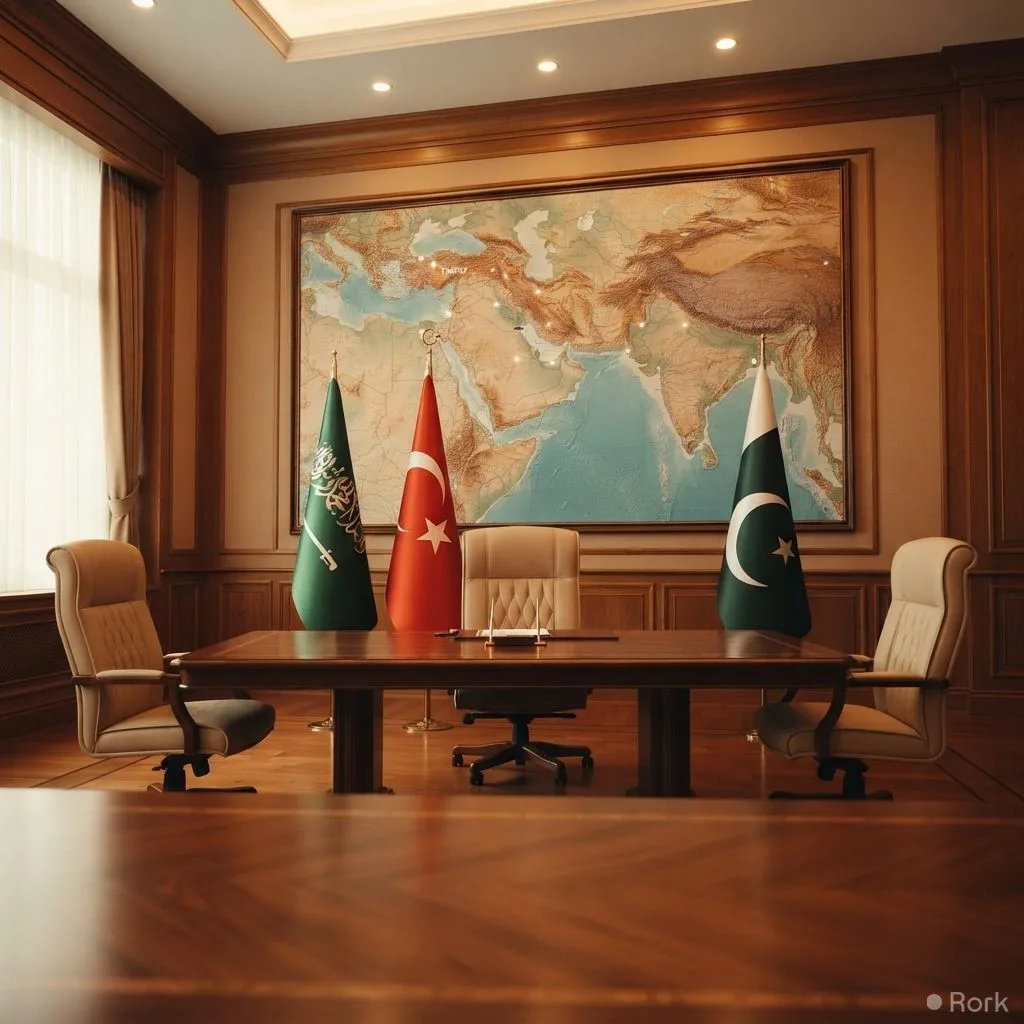
Turkey’s parliamentary speaker Numan Kurtulmuş announced on Monday that the Makkah Joint Defence Agreement, which presently binds Turkey, Saudi Arabia and Pakistan, could be broadened in the future to incorporate Iran and other Muslim‑majority states. The comment was made during a press briefing in Ankara and signals a possible shift toward a wider security framework across the Islamic world.
Kurtulmuş said the trilateral pact, signed in Makkah earlier this year to deepen military coordination among the three signatories, is being examined for expansion as part of a “broader Islamic defence architecture.” He emphasized that discussions are still at a preliminary stage and would require consensus among all prospective members, but indicated that Ankara sees strategic merit in linking the Red Sea, Gulf and South Asian theatres.
The current arrangement already envisages joint naval patrols, intelligence sharing and coordinated responses to terrorism and maritime threats. Adding Iran – a regional heavyweight with a sizable conventional force and a complex relationship with both Saudi Arabia and Turkey – would reshape the security calculus of the Middle East and South Asia. Analysts caution that Tehran’s participation would hinge on resolving lingering disputes over the Yemen conflict, the Saudi‑Iran rivalry in Syria and Iraq, and broader geopolitical rivalries involving the United States and China.
For Pakistan, an enlarged pact could bring both opportunities and challenges. Enhanced cooperation with Iran might open new channels for counter‑terrorism collaboration and facilitate joint exercises that improve interoperability with a wider set of partners. At the same time, Islamabad would need to balance its historically close ties with Saudi Arabia against any concessions required to accommodate Iranian strategic interests. Defence procurement planners in Islamabad are already assessing how a broader framework could affect existing contracts and future acquisitions, particularly in the maritime and air‑defence domains.
Regional observers note that while the proposal reflects a growing desire among several Muslim nations to develop an indigenous security network, the diplomatic hurdles are significant. Divergent political agendas, sectarian sensitivities and competing economic interests could stall or reshape any expansion talks. Nevertheless, Kurtulmuş’s remarks suggest that Ankara is actively pursuing a more inclusive defence dialogue, aiming to position Turkey as a central broker of Islamic security cooperation.
If realized, the expanded Makkah defence umbrella would mark a notable realignment, potentially linking key Middle Eastern and South Asian militaries in a coordinated framework. Such a development would have far‑reaching implications for regional stability, arms procurement markets and the strategic calculations of external powers with vested interests in the area.