
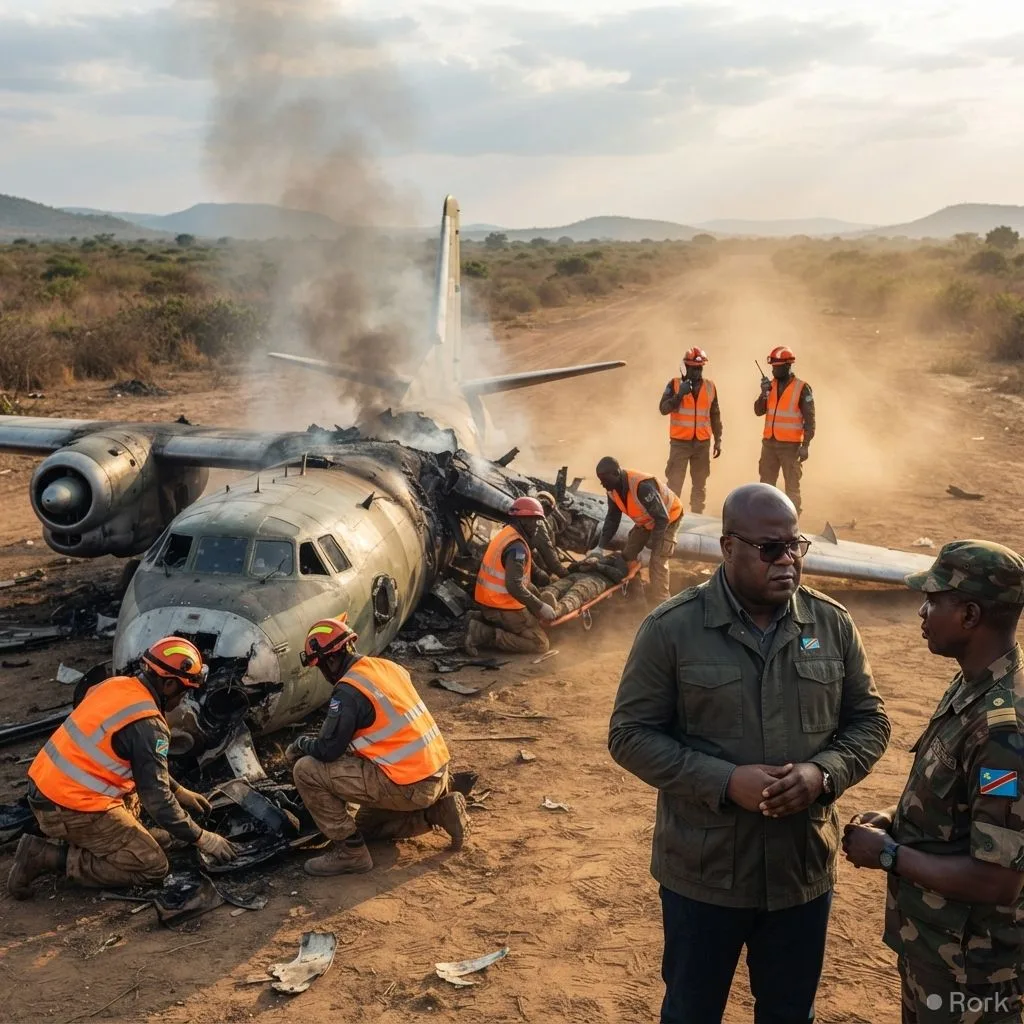
The roar of twin‑engine turboprops had become a routine sound over the eastern Congolese skies, ferrying officials and troops between remote outposts as the country grapples with persistent insurgencies. That familiar hum was shattered on Tuesday when a military transport aircraft vanished from radar, prompting frantic rescue teams to converge on a dense forest clearing near the town of Kindu.
The Transport Ministry confirmed that the flight was carrying thirteen passengers and four crew members, all of whom were killed on impact. Among those listed on the manifest were the head of the High Military Court and the armed forces’ auditor general – two senior figures who played pivotal roles in the military justice system and financial oversight of the Congolese army.
President Felix Tshisekedi, speaking from the presidential palace in Kinshasa, ordered an exhaustive inquiry into the tragedy. He urged the relevant ministries and the armed forces to cooperate fully with investigators, stressing that the cause of the crash must be identified and any negligence held to account. Emergency services, supported by the army’s medical corps, remain at the site to recover remains and gather evidence.
The loss of senior judiciary and audit officials highlights the vulnerability of the Congolese security establishment even outside combat zones. Analysts note that the Congolese military has struggled with aging aircraft and limited maintenance capacity, factors that have previously contributed to fatal mishaps. The incident is likely to reignite calls for modernising the air fleet and tightening safety protocols within the defence ministry.
For Pakistan, the development carries indirect ramifications. The Democratic Republic of Congo hosts a sizable contingent of Pakistani peacekeepers under the United Nations Stabilisation Mission, and the two nations maintain defence‑training exchanges. A destabilised Congolese military could affect joint exercises and the safety of Pakistani personnel deployed in the region, prompting Islamabad to monitor the situation closely and offer technical assistance if requested.